
Stalwart Lithops
Return to Keith's Home Page
Stalwart Lithops Cultivars

Introduction
As the bedrock of these notes has always been the two editions of Lithops-Flowering Stones by Desmond and Naureen Cole, the cultivars (later termed “aberrant colour forms”) described there within, only received scant mention in the Scrapbooks. Together with some personal comments, this section shows a little more of those “stalwart” cultivars.
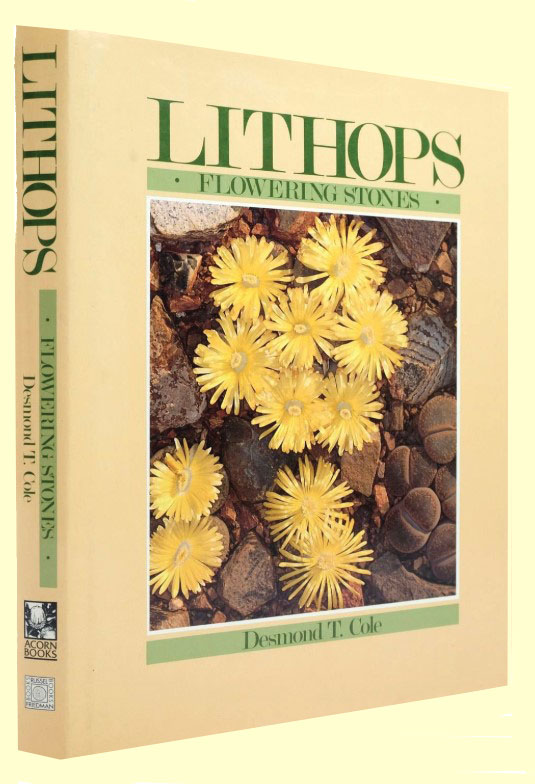
The first edition of Lithops-Flowering Stones was published in 1988, with 23 taxa recorded as cultivars.

The second edition of Lithops-Flowering Stones was published in 2005, where 2 further taxa were recorded as cultivars and the term "aberrant colour form" introduced.
Lithops N.E.Br. aucampiae L.Bol. subsp. aucampiae var. aucampiae 'Betty’s Beryl'.

Photograph © Keith Green.
Historically ‘Betty’s Beryl’ was designated *C389. This image was taken in South Africa outside the Cole residence at Highbrook, Johannesburg in 2017, the plants depicted being part of a long-standing collection tended by Will du Toit of Rustenburg, North West Province. Will timed his visit to the Coles to coincide with my arrival from the UK, but as can be seen by the remains of the flowers, I was too late to witness the aberrant white blooms. None the less the other aberration, the pleasantly marked green plant bodies, are plain to see.
*=Cole colony or collection number.
Lithops N.E.Br. aucampiae L.Bol. subsp. aucampiae var. aucampiae ‘Storm’s Snowcap’.

Photograph © Keith Green.
Historically ‘Strom’s Snowcap’ was designated *C392. This image was taken at the home of retired mine manager Will du Toit in Randburg, North West Province, South Africa during April 2025. A grower of great experience, Will houses multiple plants within the same pot and achieves excellent results. Even though the image was taken early in the day, the aberrant white of the flowers are clear to see. I my experience, this cultivar tends toward mostly open windows with tiny islands.
*=Cole colony or collection number.
Lithops N.E.Br. bromfieldii L.Bol. var. insularis (L.Bol.) B.Fearn ‘Sulphurea’.

Photograph © Keith Green.
Historically ‘Sulphurea’ was designated *C362. This is an image taken in my own collection during September of 2014. It nicely shows the aberrant green shades of the plant bodies, and the beautiful (but normal) yellow flowers fully open in the sunshine. At the time of writing in 2026, this specimen had been in my care for around 25 years, during which time many cuttings had been shared with fellow growers. Whilst I have been fortunate to have seen many specimens of var. insularis in habitat, none of those were green
*=Cole colony or collection number.
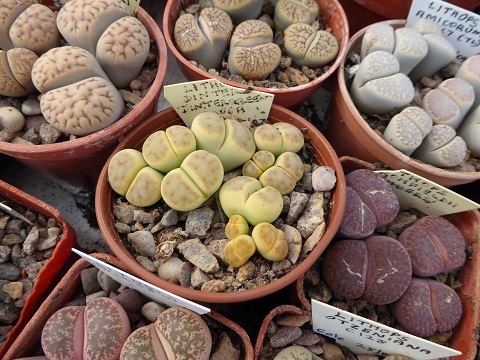
Lithops N.E.Br. dinteri Schwant. subsp. dinteri var. dinteri ‘Dintergreen’.
Photograph © Keith Green.
Historically ‘Dintergreen’ was designated *C206A. This is an image taken in the greenhouse of Suzanne Mace during August of 2019. Well known to very many mesemb. growers around the world, Suzanne and her husband Tony, have maintained a magnificent collection of succulent plants at their Sussex home for many years. Surrounded by a myriad of other Lithops, this little cluster nicely displays the delicate, pale green aberrant hues of ‘Dintergreen’.
*=Cole colony or collection number.
Lithops N.E.Br. fulviceps (N.E.Br.) N.E.Br. var. fulviceps ‘Aurea’.

Photograph © Keith Green.
Historically ‘Aurea’ was designated *C363. This image of his own specimens was taken by Ukrainian born, German resident Boris Rommer in 2023. A photographer of the highest calibre, Boris clearly shows both the aberrant green plant bodies and the aberrant white flowers of this well known cultivar.
*=Cole colony or collection number.
Lithops N.E.Br. gracilidelineata Dint. subsp. gracilidelineata var. gracilidelineata ‘Ernst’s Witkop’.

Photograph © Eric Collins.
Historically ‘Ernst’s Witkop’ was designated *C385A. On page 130 of Lithops-Flowering Stones 1988 and page 148 of Lithops-Flowering Stones 2005, the tenuous difference between var. gracilidelineata and var. waldroniae based on facial rugosity was highlighted, but the taxa upheld. The distinction between the two aberrant white flowering cultivars of each variety is likewise tenuous, but enforced by the larger flower size of var. gracilidelineata ‘Ernst’s Witkop’. Plants seem rare in cultivation however, and the photograph above is of normal, yellow flowering ex-C385 var. gracilidelineata specimens, ‘Ernst’s Witkop’ being identical except when in bloom.
*=Cole colony or collection number.
Lithops N.E.Br. gracilidelineata Dint. subsp. gracilidelineata var. gracilidelineata‘Fritz’s White Lady’.

Photograph © Keith Green.
Historically ‘Fritz’s White Lady’ was designated *C189A. On page 130 of Lithops-Flowering Stones 1988 and page 148 of Lithops-Flowering Stones 2005, the tenuous difference between var. gracilidelineata and var. waldroniae based on facial rugosity was highlighted, but the taxa upheld. The distinction between the two aberrant white flowering cultivars of each variety is likewise tenuous, but enforced by the smaller flower size of var. waldroniae ‘Fritz’s White Lady’. This image, taken in my own collection during September of 2010, highlights the small size of the flower.
*=Cole colony or collection number.
Lithops N.E.Br. hallii H.W. de Boer var. ochracea (H.W. de Boer) D.T.Cole 'Green Soapstone’.

Photograph © Keith Green.
Historically ‘Green Soapstone’ was designated *C111A. This image, which nicely displays the aberrant green body colour, was taken in my own collection during May of 2025. ‘Green Soapstone’ is well known for its pleasing colour combination of somewhat ochre windows, with pale green islands and margins. It maintains the white flowers of the species, and looks resplendent when in bloom.
*=Cole colony or collection number.
Lithops N.E.Br. hermetica D.T.Cole ‘Green Diamond’.

Photograph © Keith Green.
Historically ‘Green Diamond’ was designated *C397A. This is one of only two cultivars formally established in Lithops-Flowering Stones 2005. I took this image of a well grown, budding batch, at the home of Will du Toit in Randburg, North West Province, South Africa during April 2026. This cultivar maintains the yellow flowers of the species, but has aberrant green plant bodies with whitish facial flecks.
*=Cole colony or collection number.
Lithops N.E.Br. julii (Dint. & Schwant.) N.E.Br. subsp. julii ‘Peppermint Créme’.

Photograph © Keith Green.
Historically ‘Peppermint Créme’ was designated *C297A. This image was taken at the home of Will du Toit in Randburg, North West Province, South Africa during April 2025. The Coles documented three natural forms of subsp. julii in Lithops-Flowering Stones, those being the fuscous (brown), the reticulate (lined) and the pallid (pale), with intermediates along the way. As can be seen here, ‘Peppermint Créme’ derives from the pallid form, set apart by their ghostly green aberrant plant bodies. The classic subsp. julii lip smear is usually present to some degree or other.
*=Cole colony or collection number.
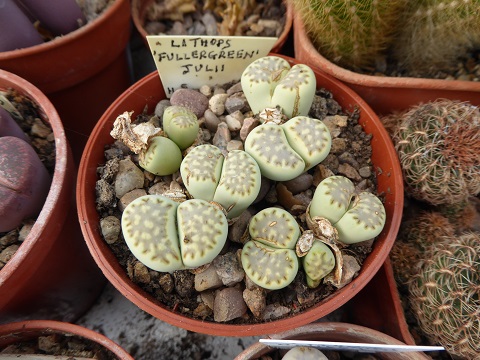
Lithops N.E.Br. julii (Dint. & Schwant.) N.E.Br. subsp. fulleri (N.E.Br.) B.Fearn var. fulleri ‘Fullergreen’.
Photograph © Keith Green.
Historically ‘Fullergreen’ was designated *C056A. I took this image taken in one of Suzanne and Tony Mace’s magnificent greenhouses during August of 2019. ‘Fullergreen’, from which many other cultivars have subsequently been developed, was among the first of many selections from L. julii. As can be seen here, they maintain the distinct boarders of subsp. fulleri, but are set apart by their aberrant greenish-grey shades, which can vary in intensity. The flowers remain white as is usual for the species.
*=Cole colony or collection number.
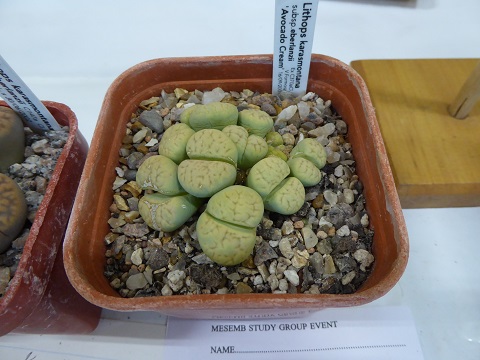
Lithops N.E.Br. karasmontana (Dint. & Schwant.) N.E.Br. subsp. eberlanzii (Dint. & Schwant.) D.T.Cole ‘Avocado Cream’.
Photograph © Keith Green.
Arising in two separate colonies, ‘Avocado Cream’ was historically designated *C370A and *C402. I took this image at the 2024 Mesemb. Study Group Event, which was held at Banstead. The exhibit is of a very nice cluster of heads, clearly displaying the “chicken scratch” facial markings typical of subsp. eberlanzii, and the aberrant cream-green head and body colours that distinguish ‘Avocado Cream’. The flower colour remains white.
*=Cole colony or collection number.
Lithops N.E.Br. lesliei (N.E.Br.) N.E.Br. subsp. lesliei var. lesliei ‘Albiflora’.

Photograph © Eric Collins.
Lithops N.E.Br. lesliei (N.E.Br.) N.E.Br. subsp. lesliei var. lesliei ‘Albiflora’.
Historically ‘Albiflora’ was designated *C005A. This image was taken by Eric Collins of Snowtown, South Australia. A farmer, nurseryman and IT consultant, Eric has an extensive collection of Lithops among many other plants. Although notable, the reddish-brown facial colours on this particular specimen fall within the normal colour spectrum of var. lesliei. It is only the aberrant white flowers (rather than the usual yellow of the species) that sets it apart.
*=Cole colony or collection number.
Lithops N.E.Br. lesliei (N.E.Br.) N.E.Br. subsp. lesliei var. lesliei ‘Albinica’.

Photograph © Keith Green.
Historically ‘Albinica’ was designated *C036A. This image was taken at the home of Will du Toit in Randburg, North West Province, South Africa during April 2025. A grower of great experience, Will’s Lithops seem to flourish as if they were growing in nature. Even though this image was taken early in the day, both the aberrant white of the flowers and the green of the plant bodies are clear to see.
*=Cole colony or collection number.
Lithops N.E.Br. lesliei (N.E.Br.) N.E.Br. subsp. lesliei var. lesliei ‘Storm’s Albinigold’.

Photograph © Will du Toit.
Historically ‘Storm’s Albinigold’ was designated *C036B. This image was taken by Will du Toit himself at his home in Randburg, North West Province, South Africa during April 2024. It is another example of how he achieves excellent results by raising multiple Lithops in the same pot. ‘Storm’s Albinigold’ has aberrant green plant bodies, but as can be seen here, produces yellow flowers as are normal for the species.
*=Cole colony or collection number.
Lithops N.E.Br. lesliei (N.E.Br.) N.E.Br. subsp. lesliei var. hornii ‘Greenhorn’.

Photograph © Keith Green.
Historically ‘Greenhorn’ was designated *C015A. This image was taken in South Africa outside the Cole residence at Highbrook, Johannesburg in 2017, the plants depicted being part of the long-standing collection tended by Will du Toit of Rustenburg, North West Province. As shown here, plants maintain the opaque nature of var. hornii, but are distinguished by their aberrant green plant bodies. Unusually, seedlings may initially appear to be of normal colour, only developing the distinct green as they mature. ‘Greenhorn’ produces yellow flowers as are normal for the species.
*=Cole colony or collection number.
Lithops N.E.Br. lesliei (N.E.Br.) N.E.Br. subsp. lesliei var. minor H.W.de Boer ‘Witblom’.

Photograph © Eric Collins.
Historically ‘Witblom’ was designated *C006A. This image of four healthy heads, was taken in the collection of my multi-talented friend come IT consultant Eric Collins of South Australia. This variety is naturally smaller than var. lesliei, and to my mind has somewhat more “chunky” facial markings. Although this picture was taken after flowering, it still gives the impression that aberrant white flowers (rather than the yellow of the species) are somehow holding on.
*=Cole colony or collection number.
Lithops N.E.Br. meyeri L.Bol. ‘Hammeruby’.

Photograph © Boris Rommer.
Historically ‘Hammeruby’ was designated *C272A. The quality of this image, taken by Ukrainian born, German resident Boris Rommer in 2023 from within his own collection, speaks for itself. The aberrant milky-red plant bodies and the divergent nature of L. meyeri are clearly shown. This cultivar flowers yellow with a white centre as is normal for the species.
*=Cole colony or collection number.
Lithops N.E.Br. optica (Marl.) N.E.Br. ‘Rubra’.

Photograph © Keith Green.
Arising in two separate colonies, ‘Rubra’ was historically designated *C081A and *C287. I took this photograph of plants, whose ancestors hail from Namibia, in the collection of a Western Cape, South African farmer during 2018. Those who work the land in Southern Africa, often have a deep respect for nature, as was the case here. These four heads clearly show the rounded profile of L. optica, the aberrant red colour for which ‘Rubra’ is famed and some well developed seed capsules. Perhaps the most famous of all Lithops cultivars, the seasonally late, but normal white flowers of ‘Rubra’, often fail to open in the poor quality light of northern European winters.
*=Cole colony or collection number.
Lithops N.E.Br. otzeniana Nel ‘Aquamarine’.

Photograph © Keith Green.
Historically ‘Aquamarine’ was designated *C128A. I took this photograph in the collection of Windhoek resident Tok Schoeman in 2013. South African born, Tok lived in Namibia for many years where he lectured Afrikaans at university level. He was an excellent grower of Lithops and simply a first rate human being. I recall him telling me this batch of ‘Aquamarine’ were “struggling” in the heat of his Windhoek home, yet whilst the shading he used does somewhat dilute the aberrant blue-green body colours, his plants looked good to me. ‘Aquamarine’, which maintains the yellow, white centred flowers of the species, was the first of several L. otzeniana cultivars to be established.
*=Cole colony or collection number.
**Lithops N.E.Br. pseudotruncatella (Berg.) N.E.Br. subsp. pseudotruncatella var. pseudotruncatella 'Albiflora'.

Photograph © Kevin Mason.
This image was taken during the 1990’s in the greenhouse of Kevin Mason of Carmarthen, South Wales. I never witnessed the flower buds open, but if the information on the label is correct (and I’ve no reason to suspect it is not), it qualifies as L. pseudotruncatella subsp./var. pseudotruncatella ‘Albiflora’, as documented by the Coles in both of their Lithops-Flowering Stones monographs. Whilst it may indeed be a Cole “aberrant colour form”, it is not a registered cultivar, since a reproducible group was never reported and we already have L. lesliei subsp./var. lesliei ‘Albiflora’. Should this same aberration be established in the future, a new cultivar epithet would be required. Although presented in cultivar format on the depicted label, ***’Alpina’ is not a registered cultivar either. It is unfortunate but since the photograph was taken, the C068 colony as also written, has been greatly reduced in size due to human activities.
**Neither a registered cultivar or C designation.
***unrecognised cultivar.
Lithops N.E.Br. ruschiorum (Dint. & Schwant) N.E.Br. var. ruschiorum ‘Silver Reed’.

Photograph © Eric Collins.
Historically ‘Silver Reed’ was designated *C387A. This is one of only two cultivars formally established in Lithops-Flowering Stones 2005. Recognised solely by the aberrant white flower (rather than the normal yellow of the species), at the time of writing (2026) plants remain rare. The photograph taken by Eric Collins of South Australia in 2026, is of a multi-headed ex-C387 var. ruschiorum specimen in his collection, ‘Silver Reed’ being identical except when in bloom.
*=Cole colony or collection number.
Lithops N.E.Br. salicola L.Bol. ‘Malachite’.

Photograph © Eric Collins.
Historically ‘Malachite’ was designated *C351A. This photograph taken by Eric Collins of South Australia in 2026, is of a multi-headed specimen in his collection, clearly showing the aberrant, opaque greenish tones that distinguish ‘Malachite’. The flowers colour is the normal white of the species.
*=Cole colony or collection number.
Lithops N.E.Br. terricolor N.E.Br. ‘Silver Spurs’.

Photograph © Bernd Schlösser.
Historically ‘Silver Spurs’ was designated *C132A. This photograph taken by diligent Lithops grower Bernd Schlösser of Germany during September 2026, clearly shows the normal plant bodies and the aberrant white flowers that distinguish ‘Silver Spurs’. Through a programme of selective breeding from appropriately marked ‘Silver Spurs’, Bernd went on to establish ‘Steamy Windows’ in 2016.
*=Cole colony or collection number.
Lithops N.E.Br. terricolor N.E.Br. ‘Speckled Gold’.

Photograph © Eric Collins.
Historically ‘Speckled Gold’ was designated *C345A. This photograph of four heads in his own collection, was taken by South Australian farmer Eric Collins, during February 2005. It clearly shows the normal yellow flowers of the species (sometimes white centred in L. terricolor), together with the aberrant yellowish-green bodies.
*=Cole colony or collection number.

The introductory flyer for the first edition of Lithops-Flowering Stones 1988.
Thank you for looking.

Photograph © Debra Green.